Showing posts with label Reading. Show all posts

Sunday, July 10, 2022

First Grade Strategy Posters

Young learners need to be explicitly taught how to decode unknown words.  Gone are the days of guessing and checking pictures for clues that may or may not help them.  Let's get with the times and explicitly teach strategies that actually WORK!  As we're teaching our students these strategies, we must provide them with visual reminders.  Having a visual at your small group table as well as in the classroom will provide students with the scaffolds they need as they're learning to decode words.  In addition to having the visuals in the classroom, send a copy home so parents can learn the strategies taught in class, too!  There's nothing more frustrating to a parent than trying to help their child read and not knowing what to do or say.

Grab these new and improved decoding strategy posters and choose the format(s) that work best for your classroom.  With 5 different formats/sizes included, you'll surely find what you need!  Click the cover below to take a closer look.


*I've also bundled my decoding strategy posters with my math strategy posters to save you a bit of
money.  Grab them both together by clicking the cover below.

xo
Megan 


Thursday, December 22, 2016

Bag-a-Book

I teach in a low-income, Title I school.  Most {over 90%} of our students receive free or reduced lunch.  Many students do not have books of their own at home.  In an effort to get books {and quality ones at that} into the hands of my students, I started a program called "Bag-a-Book."  This program was introduced to me by my awesome, brand new teammate, Jenna and I'm so glad I started it!!!

Here's how it works:

Each Friday, my students take home a bag-a-book.  They read the book {most likely someone reads it to them} at home over the weekend.  They return their books on Monday {or before the following Friday}.  Each Thursday, the students sit in a circle, in order, with their bag-a-books.  We rotate the books once clockwise.  The kids then get a new book to take home with them on Friday!


Prep-work: 

To begin, obtain enough books {one per student} for everyone in you room.  The number of books you have will last you that many weeks.  Next, print out a letter explaining the program to families. Then, number gallon sized ziploc bags with a Sharpie {or print the labels I've provided you with below}.  Assign a bag to each of your students.  *I use numbers for cubbies and mailboxes, so the kids naturally got the same number for their bag-a-books. Go over the process with your kids and stress the importance of bringing the bag-a-books back each week.  Make a big deal about it!  Once a week, rotate the books around {as mentioned above}.

Common Questions:

Where do you get the books?
I purchased books from Scholastic.  However, you could easily use books found in your classroom library or purchase books at Goodwill or any other secondhand store.

What happens if the kids lose their books?
No biggie, since most of the books were inexpensive.  I just make the student a new bag {with their same number on it} and add in a new book.  So far this year, I have only had one student lose a book.

What if the kids don't read their book?
No biggie!  If they don't read it, oh well.  I am almost certain that they will at least look at the pictures, right!?  Ideally, I'd love for someone at home to sit down with them and read to them but
exposing them to good books is fine by me if an adult isn't available!

This is such a wonderful program and I plan on continuing it for years to come!!  Thanks, new teacher, Jenna!


Grab the free bag-a-book labels and letter!  Enjoy!

xo
Megan

Tuesday, September 6, 2016

The Classroom Library

As I've said before, the classroom library is the focal point of my classroom.  It's my pride and joy.   The library is where the magic happens in first grade; it's where I give my first graders the gift of loving to read!  Today's post is all about how I manage the library.  It's in the form of a Q and A to help you understand my system.

Where did you get all those books?
Over the past 12 years, I've spent my own, hard-earned money buying ALL the books and containers for it.  MOST of the books were purchased from Scholastic Books or Half-Price Books.  I teach in a low-income school district and most months no one orders from the book orders I send home.  What I DO use Scholastic Books for is to order for myself!  I buy books, earn bonus points on my own order, and use said points to buy MORE books!  Kind of like double-dipping!

How do you organize your library?
My library is set up by theme...there are books about all sorts of things: ocean books, space books, favorite author books, non-fiction books, biographies, etc...I feel very strongly about not leveling my library.  I would never want to discourage a child from reading a book that's "not on their level." Kids learn to read by being exposed to ALL sorts of books {and a solid phonemic awareness!}.  Just because a child can't "read the words" of a book, he/she can absolutely "read the pictures!"  My library is organized using my "Basic Library Labels" set {I have other color options here, too!}. Each bin has a clear, easy-to-read laminated label on the outside.  Inside the bins are corresponding books with matching sticker labels inside the front cover.  This makes keeping the library organized so simple!


How many bins do you use in your library?
My library is pretty substantial {and it actually used to be even bigger!}.  I'll show you the before and after photos below.  This year, I wanted to scale it down a bit, so I removed all of my holiday books from the actual library and put them in a separate place.  As a holiday/event approaches, I will put out a special browsing box for those.  This has freed up a lot of room in my library.

OLD LIBRARY
NEW LIBRARY
Do you have your kids get books right when school starts?
I don't open my library the first few weeks of school.  Instead, I get a collection of back-to-school books, color, and number word books from the public library.  I put some in bins {enough for each table} and the kids quiet read from those.  I like to build anticipation with the classroom library!

Before I formally "open" the library, I explain how the books are organized.  I also make an anchor chart with my students about caring for the library.  This is an ESSENTIAL component!  Making the chart together gives the kids ownership in the library.  It makes them want to take pride in it and put the books where they belong.

After we've created the chart, I introduce a portion of the library; not the whole thing!  I tell the kids they have to show me that they can be responsible with the books before they are allowed to choose from all bins.  This helps ease us into it.  *There is a great Brain Pop Jr. video clip on choosing books that I also like to show before our first official "book shopping" day.


What system do you use for selecting books?
Everyone has their own Gallon Ziploc bag with their name on the front.  Each Friday, the kids go "book shopping."  They get to select 5 books to place in their bags.  The 5 they choose are the books they will read all week.  They are not allowed to exchange their books until Friday.  They are not allowed to trade books with friends, but they can let someone read a book for a day if they choose to.


When do your kids read the books?
My kids read their books during one of my Guided Reading groups.  I don't typically start GR until early October, so in August-September, I have a special block set up for reading time.  We start at 5 minutes and build our reading stamina until we get up to 25-30 minutes.

Hope this helps you get started!!!

xo
Megan


Sunday, May 1, 2016

Nonfiction Notebooks

Nonfiction is such an integral part of the Common Core State Standards.  As teachers, we tend to gravitate towards using fiction books for our read aloud books in class.  When we think of "classics" or favorites, we think of beloved book characters and feel-good stories.  I find that if I don't plan to use a nonfiction book as my read-aloud, it just doesn't happen.  My personal library contains LOTS of books, but the only nonfiction I have are important people, Social Studies books, and a small area for Science books.  My classroom library also contains mostly fiction books.  I've been trying to build up the nonfiction over the past few years.


The truth of the matter is, that while students enjoy hearing classics, they also LOVE having nonfiction read to them!!!   They eat it up!  Lions, Tigers, Bears, Insects, you name it!  Our kids are like little sponges that soak up what they read and learn about.

A few years ago, in an attempt to incorporate nonfiction more frequently{long before CCSS}, I created a nonfiction unit.  The unit focuses on giving children time to browse nonfiction books and take a deeper look at the components of nonfiction.  The components are compiled into a book, called  a "Nonfiction Notebook."  Teaching this nonfiction unit is one of my favorites!  I'm currently knee- deep in the middle of it now!  We started last week and are finishing up this week.  My kids have had many experiences with writing nonfiction during writing workshop.  They've also been exposed to nonfiction print {because we don't have a reading series or any materials to teacher reading other than what we buy ourselves on TpT...rant over} with Lyndsey's nonfiction reading units.  Thank goodness for those or our poor kids wouldn't have much exposure to nonfiction at all!

Below are a few pictures from our nonfiction notebook unit!  If you'd like to snag this great resource for your room, click the cover below!


xo
Megan

Monday, March 14, 2016

Literature Circles in 1st Grade

It's March, which means we are pushing our kids to get them right where they need to be by the end of the year.  If you are like me, you're exhausted and looking for challenging, yet engaging activities that your children can do.  Have you ever used literature circles with your first graders?  I have used them for many years and they are an EXCELLENT way to keep kids challenged, engaged, and having fun...especially in the spring!

By now, many of your readers are at or above grade level.  But we all have that "few" that are still struggling and still needing MUCH support.  Literature circles provide all levels of readers with the opportunity to read, discuss, and write about books.  Setup is simple:

1.  Group your students according to ability/reading level.

  • You will want to group your students into groups of 4-5.  Try not to go past 5 if possible...behavior problems can occur if your groups are too big.  If you have a para-professional {Ha!  What's that?}, you can assign them to your lowest group of readers OR you can take that group.  It would be ideal to have someone floating while the other adult is holding a group.  

2.  Select books appropriate for each group.

  • This is where the fun comes in!  You don't have to use leveled text for this.  You can pick quality literature that kids love.  All you need to do is find multiple copies.  Check your teammates, public library, school library, use listening center books, etc...For your low readers, you will want to select a guided reading book that's appropriate for their level.  However, you can use a regular book, but you will be the one reading the book to them.  It's up to you how you want your low group to look.

3.  Assign "roles" {more about that in a minute} to each member.

  • Using the provided role cards in this pack, assign each group member a role.  I've included two sets for easy differentiation; basic roles and average/advanced roles.  Included roles are:  My Favorite Part, I Want to Share, Journal, How I Feel, Book Review, Circle Leader, Story Summarizer, Question Caper, Artist, Word Detective, and Connection Caper.

4.  Copy role sheets for each member.

  • Print a role sheet for each group member.  *I keep all of my role sheets organized in a binder for quick access.  

5.  Go over the procedures/expectations.

  • Prior to launching literature circles, think about how they should look in your classroom.  What should the kids be doing?  What shouldn't they be doing?  What should the noise level be? What should they do when they are finished with their role sheet?  Management is a big part of literature circles working effectively.  Taking the time to think/talk about these things prior to starting will set both you and your students up for success.

6.  Release kids into their literature circles and watch the fun happen!

  • Once your kids are ready, let them have at it!  Below is a sample schedule of how literature circles can be used.

Monday:  Introduce new groups.  Provide time for children to read their books in their groups. Providing popcorn or pretzels is a good way to keep them busy while they read.

Tuesday: Assign roles.  Using the provided name tags, assign the days' roles to each group member. They will work on their role sheet for the day.  If they finish early, they can re-read their book.  *This is true for any day.  When everyone is finished, allow sharing time.  This is where group members will share out their role sheets and the other members can ask questions/give compliments/etc...

Wednesday: Assign new roles.  Using the provided name tags, assign the days' roles to each group member.  They will work on their role sheet for the day.  If they finish early, they can re-read their book.  *This is true for any day.  When everyone is finished, allow sharing time.  This is where group members will share out their role sheets and the other members can ask questions/give compliments/etc...

Thursday:  Repeat Wednesday's process of assigning new roles.

Friday:  Repeat Thursday's process of assigning new roles.

*At any time, kids are welcomed to re-read their books.  This will be especially helpful for those who have the more challenging role sheets.


To try literature circles in your own classroom, click below!  You won't regret it!  


xo
Megan 

Wednesday, February 17, 2016

I ((Puffy Heart)) LOVE Junie B. Jones

If you've followed my blog for any length of time, or even know me personally, you will know that I am obsessed with Junie B. Jones.  It all started 14 years ago when I was student teaching.  My cooperating teacher {who was awesome, BTW} read it religiously to her class every day...1 chapter each day immediately following recess.  When I graduated, she gave me a few of my first JBJ books. I knew I had to build up my collection, but as a first year teacher, I was BROKE!  I would find the books at the library and make sure I always had a back up on hand when it was time for us to start a new book.

As the years progressed, I bought all of my own JBJ books.  I would find them at garage sales, secondhand book stores, and on Scholastic Book's website.  I found that I had lots of multiple copies {more on that later} but I didn't really care.  I figured some would wear out and I'd have to replace them eventually.  Can we say Hoarders: Junie B. Jones Edition??!!


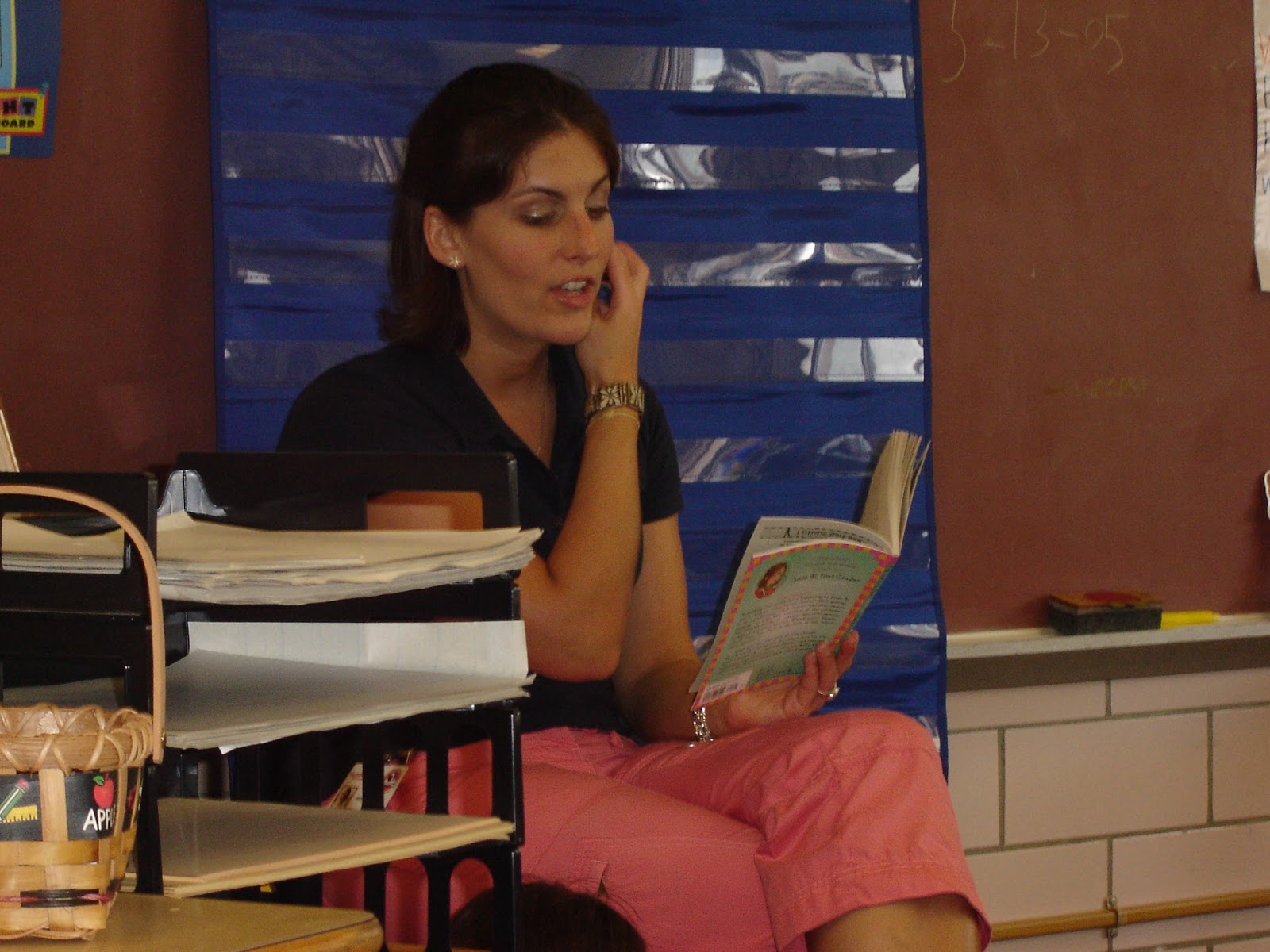
I carried on the tradition of reading JBJ each day after recess.  No questions asked.  That is one time of day that I NEVER skip.  It's a joyful time, when my students and I can come together and ENJOY A BOOK JUST BECAUSE.  No thinking required.  Just my kids, me, and a lot of laughs!  This is also one time of day when the kids are SILENT.  No one wants to miss a funny part!  This picture below is me during my first year of teaching first grade!  Circa 2004!


Over the years, I noticed that kids would start getting their own JBJ books at their libraries or bookstores and bring them in to "follow along" {I use that term very loosely for obvious reasons!}. The main part they are obsessed with is showing the pictures, just like their teacher does.  It always warms my heart to see my kids develop such a love of reading through this quirky character known as Junie B. Jones!

Remember that I mentioned above that I have *many* multiple copies of each JBJ book?  Well that has come in handy!  I draw name sticks and give out the extra copies of the book we are currently reading for kids to "follow along" with.  They LOVE this!  In addition, during quiet reading time, the kids who are reading above grade level are allowed to choose one JBJ book for their book baggie for the week.  This is also very exciting!

For Christmas or End of Year {or both} gifts, I always gift my students with the love of JBJ!  Last year, I even found Valentine cards!  The kids flipped when they got them on Friday!


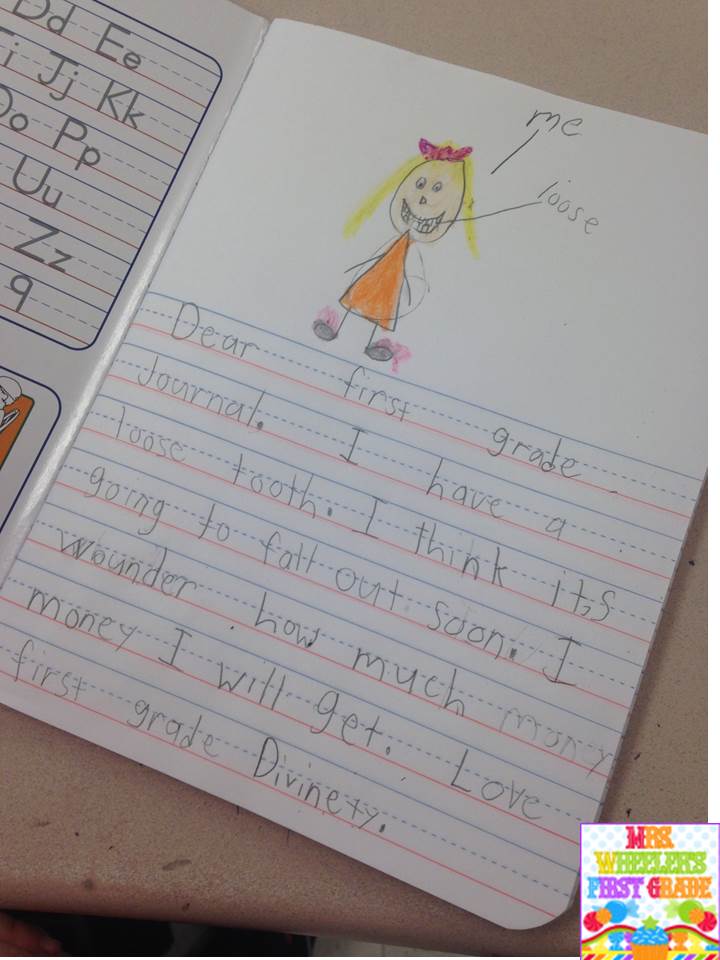
This year, I even had my kids start their very own "First Grade Journals," just like Junie B.!  *Idea inspired by Ashley Reed.  I had these composition journals in my cabinet for years and never knew what to do with them.  Let's just say you could hear a pin  drop in the classroom during journal time, which is every day, immediately following JBJ read-aloud.  The kids have 12 minutes to free write. This is completely separate from our Writing Workshop time.  Their entries are so adorable!  Here are some of them so far:


If you haven't checked out Junie B. Jones, I highly recommend it!  The books keep fun in the classroom and really help students develop a love of reading!  You can visit the Random House website to sign up for the JBJ newsletter and get the free checklist, bookmarks, and lots of other gems!  To win a starter set of JBJ books for you classroom, just enter the Rafflecopter below!

a Rafflecopter giveaway

Tuesday, January 12, 2016

Accelerated Reader

Do you use Accelerated Reader at your school?  If you aren't familiar with it, AR is an online comprehension program for students.  They read a book on their AR level and then take a quiz over it online after.  Those of you who don't have AR at your school: this post will probably be irrelevant to you!  

I begin putting students who are reading at a guided reading level of F/G or higher on AR.  Those reading at levels lower than that really can't read the books we have in our library independently. Each child has a card with their level, username, and password on it.  Each week when we go to library, those students can pick out 2 books on their level for the AR bucket.   I have a schedule that shows when each child is allowed to read and take an AR quiz each week {I only have 3 computers and no tablets/etc in my room, so I can't have 10 kids hovering over the computers.  A schedule was in order!}.  


When it's their day, the students select a book on their level, read it 2 times, take an AR test on it, and complete their AR tracker sheet.  *In order to write down their quiz score, they must get an 80% or 100% on the test.  Once a student's AR tracker sheet is full, he/she can choose a reward {eat in classroom with me, visit a former teacher, treat, treasure box, etc...}.  This helps motivate the kids to read, read, read!

Students read during silent reading time when it is their day for AR.  They can also read a book and take a test as an early finisher activity.


PS-I have 6 friends who have met their goal for the year!  WOO HOO!  The graph shown below as well as the AR tracker sheet can be found HERE.


xo
Megan

Sunday, November 22, 2015

Turkey Trot Blog Hop


Hi, friends!  Thank you to my bestie Jess for sending you my way!  Gobble, Gobble!  Some of my favorite bloggers and I have teamed up to offer you freebies to show how thankful we are for you!  Today, I am offering 4 free graphic organizers to you.  This is a sample from my "Differentiated Graphic Organizers" pack.  This is such a wonderful resource to have on hand for whole-class reading instruction, guided reading, or those "on the fly" moments when you need a little something.  I have all of my organizers printed and in file folders so they are always ready. Click the cover below to grab a free sample from this pack.  


Thank you for stopping by!  Trot on over to Lori's blog, Teaching with Love and Laughter, where you can snag another great freebie!  *And thank you, Lori, for making our button for the hop!  Happy Turkey Day!  


Photobucket
xo
Megan